
Hyperbaric Chamber ROI Calculator: How Many Sessions to Break Even?
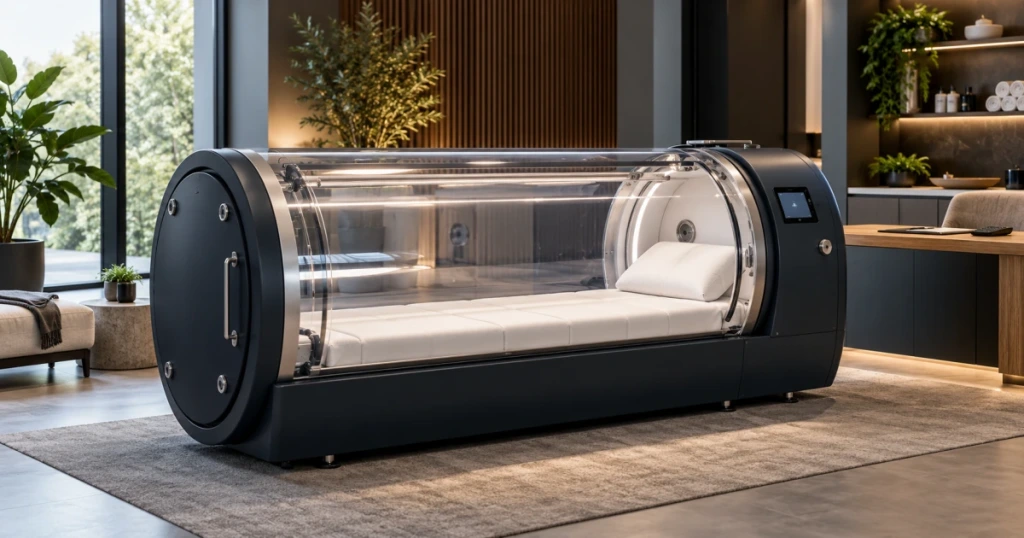
A hyperbaric chamber can look profitable on paper and still create a cash-flow problem. Four inputs shape the result: the landed opening cost, the average collected price per session, the variable cost per session and the new monthly fixed cost. This hyperbaric chamber ROI calculator turns those inputs into a session target you can test before requesting a quote.
TL;DR: Monthly operating break-even sessions equal fixed monthly costs divided by contribution per session. In the example below, US$4,000 divided by US$130 equals 30.8. Round that up to 31 paid sessions per month, or about 1.4 per operating day across 22 days. This is a planning example, not an earnings forecast.
If you still need to estimate equipment, delivery and opening costs, begin with Oxycron’s hyperbaric chamber business cost guide. Then return here to test whether your expected demand supports the investment.
How Does the Hyperbaric Chamber ROI Calculator Work?
The U.S. Small Business Administration defines break-even units as fixed costs ÷ (selling price − variable cost per unit). For this model, one completed paid session is one unit. The same framework works for a wellness studio, recovery center or other commercial facility, provided every input comes from that specific business.
The calculation produces three different answers. Do not combine them:
| Question | Formula | What it tells you |
|---|---|---|
| How much does one session contribute? | Collected price − variable cost | Money available to cover fixed costs and investment |
| How many sessions cover monthly operations? | Monthly fixed cost ÷ contribution per session | Operating break-even volume |
| How long could capital recovery take? | Opening investment ÷ monthly operating surplus | Simple payback at a stated run rate |
Important: simple payback is not the same as accounting profit, return on invested capital or cash-on-cash return. Taxes, financing, depreciation, owner compensation, downtime and working-capital changes may alter the result. Use the calculator as a screening tool, then review the plan with qualified local financial, legal and regulatory advisers.
Step 1: What Is Your Landed Opening Investment?
Your opening investment is not the chamber’s catalog price. It includes every one-time cost required to move from an equipment order to a room that is ready for safe, lawful operation. Oxycron’s October 2026 indicative equipment ranges are about US$3,500–6,500 for soft-shell systems and US$11,000–63,000 for hard-shell systems, before project-specific costs.
Build the opening investment from these categories:
- Chamber, compressor, oxygen source, cooling, communication and selected options
- Export packing, freight, cargo insurance, import charges and destination delivery
- Doorway or access work, electrical work, ventilation, finishes and room preparation
- Installation, commissioning, training, opening supplies and safety equipment
- Permits, professional advice, insurance deposits, launch marketing and contingency
ICC’s Incoterms® 2020 checklist shows that delivery, risk and cost responsibilities change with the chosen rule and named place. A quote marked only “FOB,” “CIF” or “DAP” is therefore not enough; record the precise location and which party pays each destination charge.
The SBA also recommends adding roughly 10% to a break-even analysis for miscellaneous expenses that cannot be predicted. Use that as a planning reminder, not a universal rule. A site with difficult access, unusual electrical requirements or complex local review may need a different contingency.
For a complete checklist, see the hyperbaric chamber installation requirements.
Step 2: What Is the Contribution per Paid Session?
Contribution per session is the average amount left after costs that rise when one more session is delivered. Use the average collected price, not the public list price. Discounts, packages, refunds and unpaid bookings can make the collected amount lower than the number on your service menu.
Use this formula:
Contribution per session = average collected price − variable cost per completed session.
Variable costs may include payment processing, directly consumed oxygen or electricity, laundry, disposable items and labor that is scheduled only because that session occurs. Base rent, salaried management, insurance, software, minimum utility charges and routine marketing normally belong in fixed cost instead.
Do not make medical reimbursement assumptions unless the exact service, provider, device, jurisdiction and payer requirements have been verified. A wellness cash-pay model and a clinical reimbursement model are different businesses and need separate calculations.
Step 3: How Many Sessions Cover Monthly Operating Costs?
Operating break-even tells you the paid volume needed to cover incremental monthly fixed costs. It does not repay the opening investment. In the example, US$4,000 divided by US$130 equals 30.8, so the business must complete 31 paid sessions per month before it produces an operating surplus.
Across 22 operating days, 31 sessions equal about 1.4 paid sessions per day. Always round the target up. A fraction of a session cannot be sold, and actual monthly demand will rarely arrive in a perfectly even pattern.
| Example input | Amount |
|---|---|
| Average collected price | US$150/session |
| Variable cost | US$20/session |
| Contribution | US$130/session |
| Incremental monthly fixed cost | US$4,000 |
| Operating break-even | 31 sessions/month |
Include a realistic maintenance reserve inside fixed cost. The hyperbaric chamber maintenance cost guide explains which preventive, service and spare-parts lines should be priced before purchase.
Step 4: How Do You Estimate Capital Payback and Cash Runway?
Simple capital payback divides opening cost by monthly operating surplus. In this example, the project costs US$50,000 to open and later produces US$4,580 per month after fixed costs. That gives a simple payback of about 10.9 months at the steady run rate. It does not mean the project repays itself 10.9 months after opening.
New services normally ramp. In this example, the business reaches its three-session daily target in steps: 40%, 55%, 70%, 80%, 90% and 100% over six months. It produces about US$13,180 in total operating surplus during that period. At the later US$4,580 monthly run rate, the remaining capital needs about eight more months. The adjusted simple payback is roughly 14 months, before tax, finance costs and unexpected downtime.
The SBA advises founders to account for one-time costs and monthly expenses, and says counting at least one year of monthly expenses gives a more realistic startup view. Keep a separate cash-runway calculation:
Opening cash need = landed opening investment + cumulative operating deficits during ramp-up + contingency.
A project can have attractive long-term unit economics and still fail because it runs out of cash before demand matures. That is why runway belongs beside ROI in every purchase decision.
What Do Three Utilization Scenarios Show?
Scenario planning is more useful than a single forecast. The table uses 22 operating days, US$130 contribution per session, US$4,000 in monthly fixed costs and a US$50,000 opening cost. It shows how the outcome changes at two, three or five paid sessions per day.
| Paid sessions/day | Sessions/month | Monthly operating surplus | Simple payback at steady run rate |
|---|---|---|---|
| 2 | 44 | US$1,720 | 29.1 months |
| 3 | 66 | US$4,580 | 10.9 months |
| 5 | 110 | US$10,300 | 4.9 months |
Example only: the table is not an Oxycron earnings claim. It leaves out tax, finance costs, depreciation, owner pay, ramp-up, refunds and unexpected downtime. Replace every input with figures from your own market and obtain professional advice.
Want Oxycron to check the equipment side of your model? Send your country, facility type, room dimensions, preferred capacity and expected sessions per day. The team can narrow suitable configurations and define a more complete landed-cost scope.
How Does Chamber Configuration Change the ROI Model?
Chamber selection changes both the numerator and denominator of ROI. A higher-capacity system can increase bookable seats, but it may also require more capital, space, site work, supervision and demand. Buying capacity that remains empty usually weakens ROI rather than improving it.
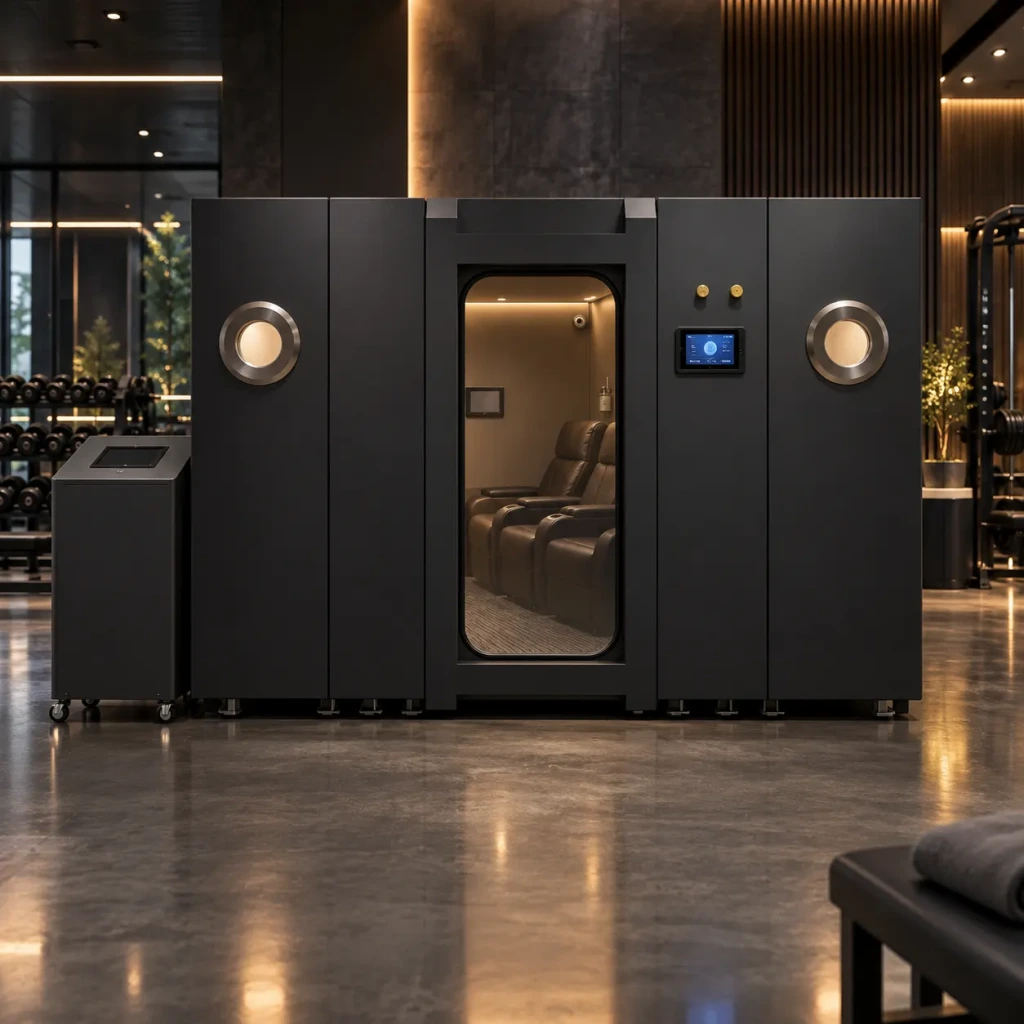
| Decision | Potential ROI effect | Question to validate |
|---|---|---|
| Soft-shell vs hard-shell | Different opening cost, room presentation and operating scope | Which construction fits the intended use and local requirements? |
| Single-person vs multi-person | Different throughput, privacy, scheduling and staffing | Can demand fill the additional capacity at the same time? |
| Seated vs lying | Different footprint, access and customer experience | Which position fits the room and target customer? |
| Pressure and system specification | May change equipment, documentation, training and site needs | What is permitted for the exact intended use and market? |
Use the soft-shell versus hard-shell guide and the single-person versus two-person comparison before assigning a capacity number to the spreadsheet.
Which Safety and Compliance Costs Belong in the Model?
Safety is an operating requirement, not an optional cost to remove when ROI looks weak. The FDA’s August 25, 2025 safety letter emphasizes six areas: instructions for use, fire prevention, staff training, user monitoring, cleaning and maintenance, and prohibited-item controls. Each area can affect staffing, room design, procedures and recurring cost.
For the U.S. market, FDA lists hyperbaric chambers under product code CBF as Class II devices subject to 510(k) review. The same classification page recognizes NFPA 99:2024 and ASME PVHO-1:2023. ASME states that PVHO-1 covers pressure vessels for human occupancy with a pressure differential exceeding 2 psi, including hyperbaric chambers.
ISO says ISO 13485:2016 applies to quality-management systems for medical-device organizations and was reviewed and confirmed in 2025. In the EU, the European Commission identifies four central economic-operator roles—manufacturer, authorised representative, importer and distributor—each with responsibilities under the MDR.
The wellness-center safety checklist can help convert these obligations into operating-cost lines.
What Information Produces a Useful Chamber Proposal?
A supplier cannot improve your ROI model with only “send best price.” A useful proposal starts with six facts: destination, facility type, intended use, room and access size, required capacity and expected sessions per day. Add the opening date, power supply, document needs and support expectations so each quote covers the same scope.

Copy this ROI-ready request list
- Country, city and final delivery location
- Facility type and intended commercial use
- Room, doorway, corridor and elevator dimensions
- Expected paid sessions per day and operating days per month
- Required user capacity and seated or lying preference
- Pressure range or application to be reviewed
- Voltage, frequency, plug and room conditions
- Required market documents, training and service scope
- Preferred Incoterm, named place and opening target
After receiving proposals, use the hyperbaric chamber supplier checklist to compare model identity, test records, manuals, warranty, spare parts and service responsibilities.
What ROI Mistakes Should Buyers Avoid?
The most common mistake is using the most optimistic number in every cell. A higher list price, full schedule, zero downtime and lowest equipment quote may each be possible separately, but combining all four creates a fragile forecast.
Using advertised price instead of collected price
Packages and discounts lower the average collected amount. Calculate revenue from actual payment expectations after discounts, refunds and no-shows.
Confusing capacity with demand
Five available appointments do not equal five paid sessions. Build conservative, expected and strong-demand cases, then apply a monthly ramp-up.
Ignoring cleaning, turnover and downtime
Bookable time must allow user preparation, supervision, room reset, cleaning, routine checks and maintenance. Practical capacity is always lower than theoretical clock capacity.
Comparing incomplete equipment quotes
A low unit price may exclude oxygen equipment, cooling, freight, import charges, installation, training or spare parts. Compare landed scope line by line.
Treating compliance as a one-time folder
Training, records, maintenance, insurance, permitted claims and post-market responsibilities continue after opening. Include recurring work in the operating model.
Frequently Asked Questions
What is a good ROI for a hyperbaric chamber?
There is no universal “good” percentage. Compare the project’s risk, cash needs and payback with your other investment options. Start with the SBA break-even formula, then model at least three demand cases. If the conservative case cannot cover monthly fixed costs, validate demand or reduce scope before ordering.
How many sessions does a chamber need to break even?
Divide monthly fixed cost by contribution per paid session. In the article’s example, US$4,000 ÷ US$130 equals 30.8, rounded to 31 sessions per month. Across 22 operating days, that is about 1.4 sessions daily. Replace all inputs with local figures.
How long does a hyperbaric chamber take to pay for itself?
Payback depends on landed cost and monthly operating surplus. In the example, US$50,000 divided by US$4,580 equals 10.9 months at steady volume. A six-month ramp-up extends the result to roughly 14 months, before tax, finance costs, depreciation and unexpected downtime.
Should I buy a larger chamber to improve ROI?
Only when demand can fill the added capacity. Moving from one to multiple users may improve throughput, but it can also increase investment, space, staffing and scheduling complexity. Compare at least three utilization levels and use the single-person versus two-person guide before assigning revenue to empty seats.
What costs are commonly missing from chamber ROI calculations?
Common omissions include freight, import charges, access work, electrical upgrades, ventilation, training, insurance, cleaning, payment fees, maintenance reserve, marketing and cash deficits during launch. SBA guidance recommends considering a 10% buffer for unpredictable items, but each project should price its own risks.
Turn Your ROI Estimate Into a Quote-Ready Project
A useful hyperbaric chamber ROI calculator does not promise profit. It shows the paid session volume your facility must achieve, the cash required during ramp-up and which equipment assumptions need verification. Use conservative demand, complete landed cost and a maintenance reserve; then test whether the project still makes sense.
Ready for a model-specific proposal? Contact Oxycron with your country, facility type, room dimensions, preferred capacity, expected sessions per day and opening target. The team can help shortlist suitable configurations and define equipment, delivery, documentation and support scope for your calculation.
Disclosure: Oxycron equipment ranges are indicative as of October 2026 and may change with model, setup, options, currency, destination and support scope. All financial figures are examples, not earnings forecasts. This article is general purchasing information, not medical, legal, regulatory, tax, accounting or investment advice.
Sources
- Oxycron: Hyperbaric Chambers for Sale — indicative equipment price and configuration context
- U.S. Small Business Administration: Break-Even Point — formula, cost definitions and planning buffer
- U.S. Small Business Administration: Plan Your Business — one-time and monthly startup-cost planning
- FDA: Follow Instructions for Safe Use of HBOT Devices — August 25, 2025 safety recommendations
- FDA: Hyperbaric Chamber Product Classification — Class II, product code CBF and recognized standards
- ISO 13485:2016 — medical-device quality-management-system scope and current status
- European Commission: Medical Device Economic Operators — MDR roles and responsibilities
- ASME PVHO-1:2023 — scope for pressure vessels for human occupancy
- ICC: Incoterms® 2020 Checklist and Flowcharts — delivery, risk and cost allocation